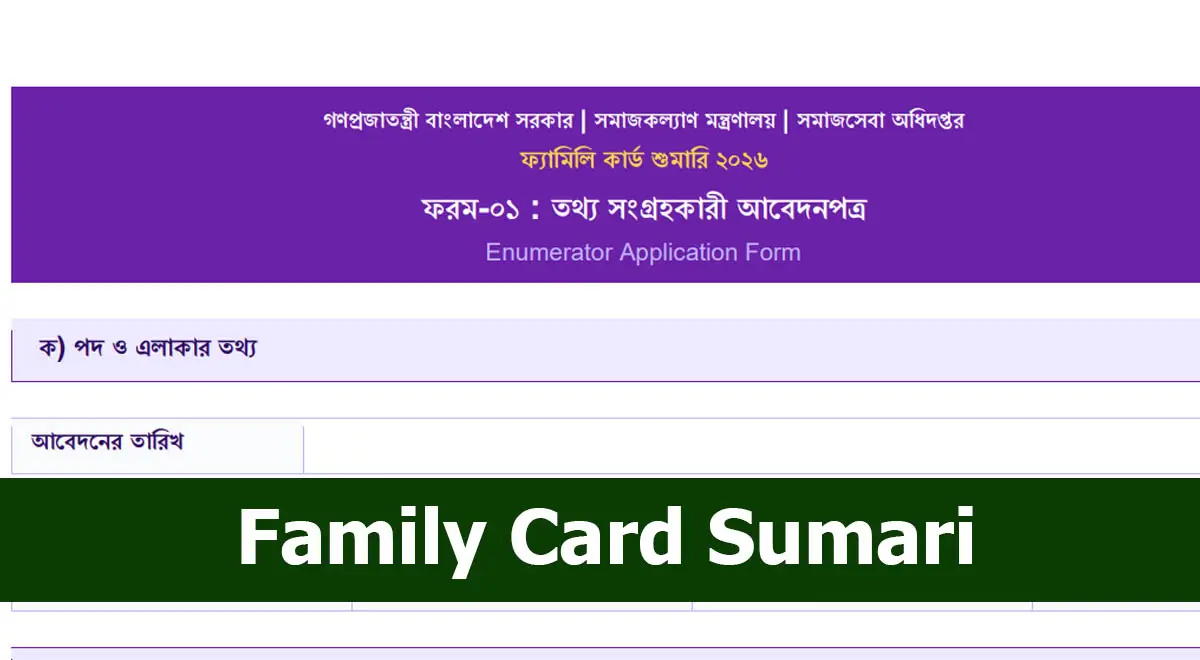
Family Card Sumari
The Family Card Sumari 2026 (ফ্যামিলি কার্ড শুমারি) is scheduled to begin across Bangladesh on 1 August 2026. As part of the nationwide programme, trained data collectors will visit homes to collect and verify household information. The census is being conducted under the Department of Social Services and the Ministry of Social Welfare.
This nationwide initiative is designed to build a modern, transparent digital database of families across the country. The survey aims to collect social and economic information from households so the government can accurately identify families that qualify for current and future social safety net programs.
Bangladesh has several social welfare programs, but identifying the right beneficiaries has often been a challenge. By transitioning to a reliable, family-based digital database, the government aims to prevent ineligible people from receiving multiple benefits while ensuring deserving families are not left out.
What Is the Family Card?
A Family Card is a government system that identifies a household as a single unit instead of treating each family member separately. The card stores critical information about the entire family in one secure digital record.
During the census, enumerators will collect data to assess a family's overall economic condition, including:
- Family members' identities
- Income and primary occupation
- Type of residence & housing conditions
- Education information
- Health-related details
- Disability or special needs
- Household assets
Key Targets & Dates
Based on official announcements and the "Family Card Census Guidelines-2026", the government has set ambitious targets to bring millions of families under this scheme.
Strict Schedule
Data collection across the country will run uninterrupted for 45 days, starting on August 1, 2026 to September 14, 2026. Please ensure family members are available during this window.
Workforce & Recruitment
The Family Card Sumari 2026 is one of the country's largest household data collection programmes. More than 60,000 field workers and monitoring officials are being deployed across urban and rural areas by the Department of Social Services.
Census Workforce Breakdown
Eligibility for Data Collectors
To ensure high-quality digital data entry, applicants must meet specific requirements:
- Age & Education: 18-40 years old; minimum HSC or equivalent.
- Tech Skills: Must score at least 70% in a practical tablet/smartphone test.
- Priority Given To: Female applicants (target 50% per upazila).
- Preferred Experience: Bachelor's degree holders or past BBS survey experience.
Eligibility for Supervisors
Supervisors will oversee field operations and maintain data quality:
- Age & Education: 25-45 years old; minimum Bachelor's degree.
- Tech Skills: Must score 80% or above in the web app/tablet test.
- Local Knowledge: Good understanding of local areas and ward boundaries.
- Soft Skills: Strong leadership and communication capabilities.
Interested in Applying?
People interested in working as data collectors or supervisors are advised to contact their nearest Social Services Office for official application procedures, recruitment updates, and eligibility confirmations.
Survey Process & Duties
The survey will be carried out through extensive door-to-door visits by locally appointed Data Collectors and Supervisors.
In a major modernization step, enumerators will use tablets and the CAPI (Computer-Assisted Personal Interviewing) method to enter data directly into digital devices during the visit, minimizing errors and paperwork.
Key Duties of Supervisors
Supervisors will monitor field activities daily to maintain the quality of the census. Their strict responsibilities include:
- Visiting each Enumeration Area (EA) daily.
- Re-checking 5% to 10% of surveyed households.
- Submitting daily reports through the official web app.
- Reporting technical problems to the Upazila Committee immediately.
Residents are requested to cooperate with authorized officials carrying valid IDs and provide correct information.
Mandatory Rules & Documents
To ensure transparency and eliminate duplicates, the government has introduced strict guidelines for registration:
"One Family, One Card" Policy
Multiple applications using the same family information or NID are strictly prohibited. The centralized system will cross-check all NIDs automatically.
When enumerators visit, families should have the following ready:
- National Identity Card (NID): Mandatory for the applicant/head of household.
- Active Mobile Phone Number: Essential for receiving OTPs and official SMS notifications.
- Birth Registration Certificate: Required for family members who do not yet have an NID.
Is a Card Guaranteed? (Myths vs. Facts)
No. Participating in the census does not automatically guarantee a Family Card.
This is a data-gathering exercise. After data collection, field verification and Proxy Means Test (PMT) scores will be used. Only families that meet the government's specific eligibility criteria (low-income, poor, vulnerable households) will be selected to receive cards in phases.
Security Warning
Never pay money: The census is 100% free. Report anyone demanding money.
Protect Data: Never share banking PINs, mobile banking passwords, or OTPs with data collectors.